
The question it answers
How many people reach my site from ChatGPT and other AI answers, and which pages are the AI crawlers reading?
What it is
AI search sends you two different kinds of traffic. The first is people: someone asks ChatGPT, Perplexity, Gemini, Copilot or Claude a question, sees your page cited, and clicks through. Those visits arrive with the assistant as the referrer, and cite-met shows them as traffic sources and, from the Local plan, as the entry point of each visitor journey. The second is crawlers: OAI-SearchBot, Claude-SearchBot and PerplexityBot building search indexes, ChatGPT-User, Claude-User and Perplexity-User fetching a page because someone asked, and training crawlers such as GPTBot and ClaudeBot. cite-met reads those requests at the edge for the sites it hosts and charts them by crawler and page.
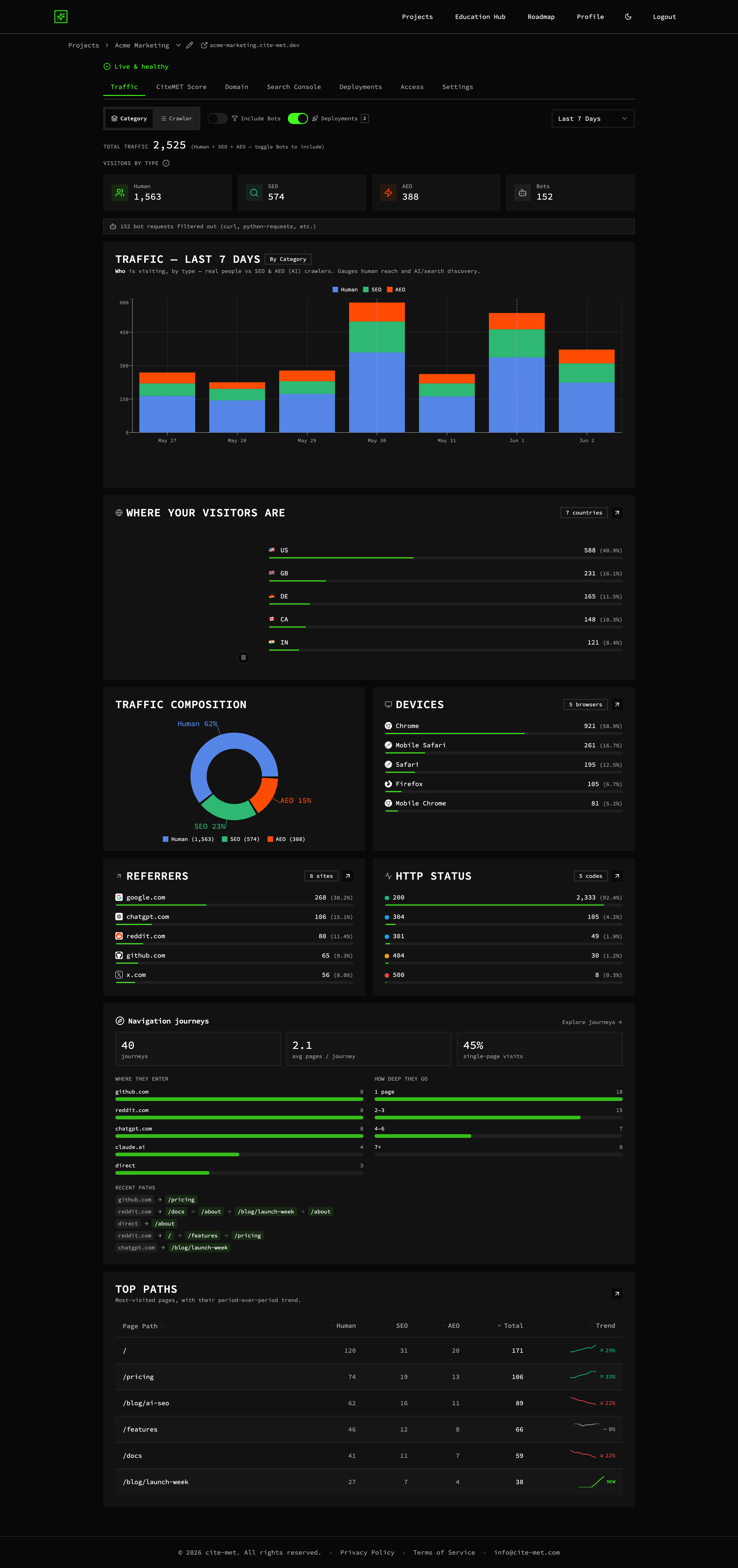
Traffic analytics with Human, SEO, and AEO visitor types charted separately (example data)
Visits from AI answers
ChatGPT, Perplexity, Gemini, Copilot and Claude as traffic sources, next to Google and direct.
AI crawler fetches by page
Search crawlers, user-triggered fetchers and training crawlers, for sites we host.
Where AI visitors go next
From the Local plan, journeys show what people from AI answers read after they land.
A concrete example
In the example project above, 2,525 visits in seven days split into 1,563 Human, 574 SEO and 388 AEO. The Human stream is where people from AI answers show up, by source, next to Google and direct visits, while the AEO stream counts AI crawler fetches by crawler. Read together, they show whether the pages AI crawlers fetch are the same pages that people from AI answers land on. The figures are example data.
Why it matters
Google Analytics 4 now groups visits from AI assistants in its AI Assistant channel, but it can't see AI crawlers at all, and an assistant that sends no referrer shows up as Direct. Clicks from Google's AI Overviews and AI Mode count as Google search, not as an AI source. Seeing the people and the crawlers in one place tells you whether AI search can read your pages and whether it is sending you anyone, without stitching two tools together.
More of the platform
CiteMET Score →
A live A+ to F grade for how readable your site is to search and AI crawlers, with a list of what to fix.
AI-Crawler (AEO) Analytics →
See which AI crawlers fetched which pages, next to human and search traffic.
Visitor Journeys →
Sessionized navigation paths: where visits enter, how deep they go, where they stall.