
The question it answers
Is my site working right now, and if it is not, what are visitors seeing and what do I do?
What it is
A verbose health verdict that surfaces only when something needs attention. It aggregates deploy status, uptime, SSL/DNS, and placeholder-serving detection into one banner that says in plain English what's wrong, what the public is seeing right now, and how to fix it. Failed builds are classified (SSR config missing, dependency install failed, build command errored) instead of dumping raw logs. When a site goes down or recovers, cite-met emails the owner and team with the same plain-language verdict, at most once per incident, so no alert storms.
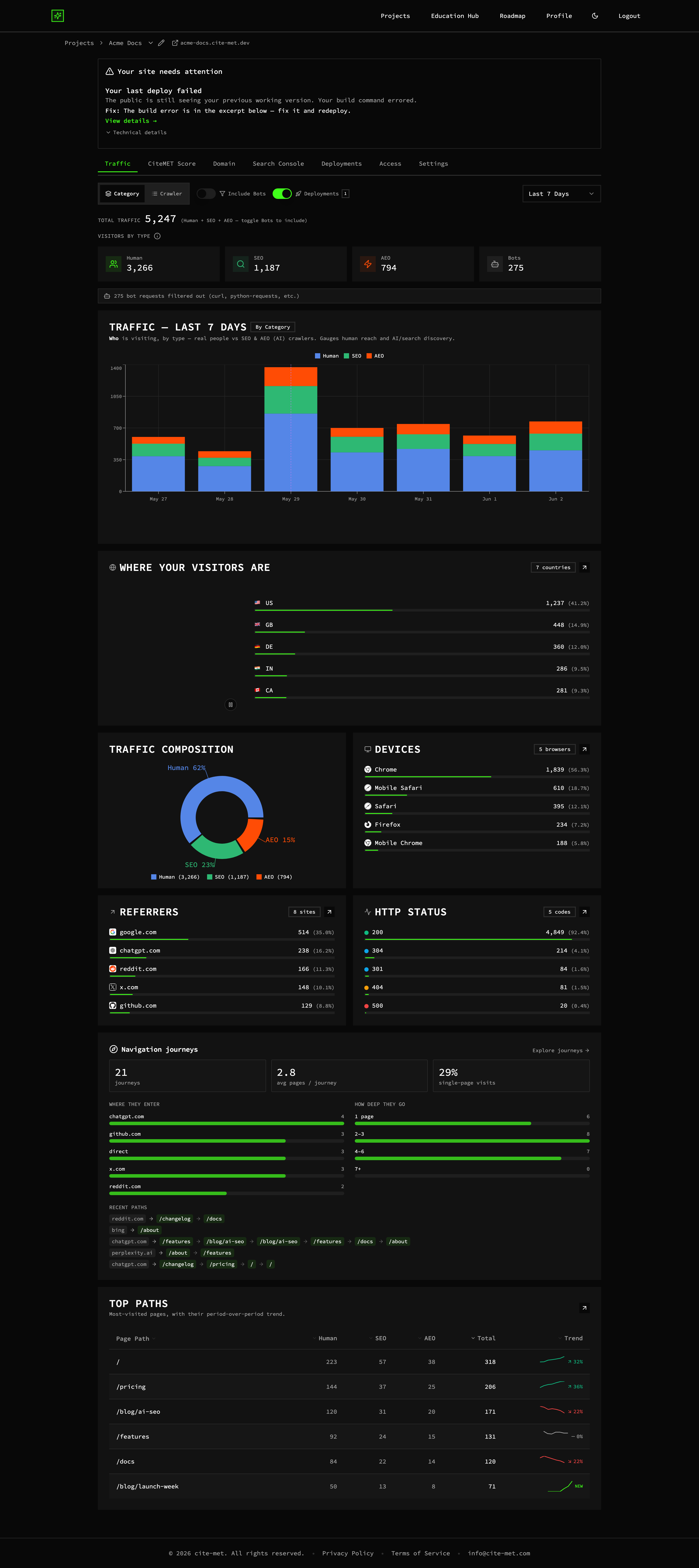
Site Health panel explaining in plain language what needs attention (example data)
Plain-English verdicts
What's wrong, what the public sees now, and how to fix it.
Classified build failures
SSR config, dependency install or build command, not raw log dumps.
At-most-once alarms
Outage and recovery emails without alert storms.
A concrete example
In the example project, a failed build puts this at the top of the dashboard: "Your last deploy failed. The public is still seeing your previous working version. Your build command errored." Under it is the fix: the build error is in the excerpt below, so fix it and redeploy. When a site goes down or recovers, the owner and team get an email with the same plain-language verdict, at most once per incident. The project is example data.
Why it matters
Non-engineers understand it and engineers skip straight to the cause. And proactive outage comms turn a reliability event into a trust-building moment — your customers hear it from you first, not from theirs.
More of the platform
CiteMET Score →
A live A+ to F grade for how readable your site is to search and AI crawlers, with a list of what to fix.
AI-Crawler (AEO) Analytics →
See which AI crawlers fetched which pages, next to human and search traffic.
AI Search Traffic Analytics →
People who arrive from AI answers, and the AI crawlers behind them, in one view.